
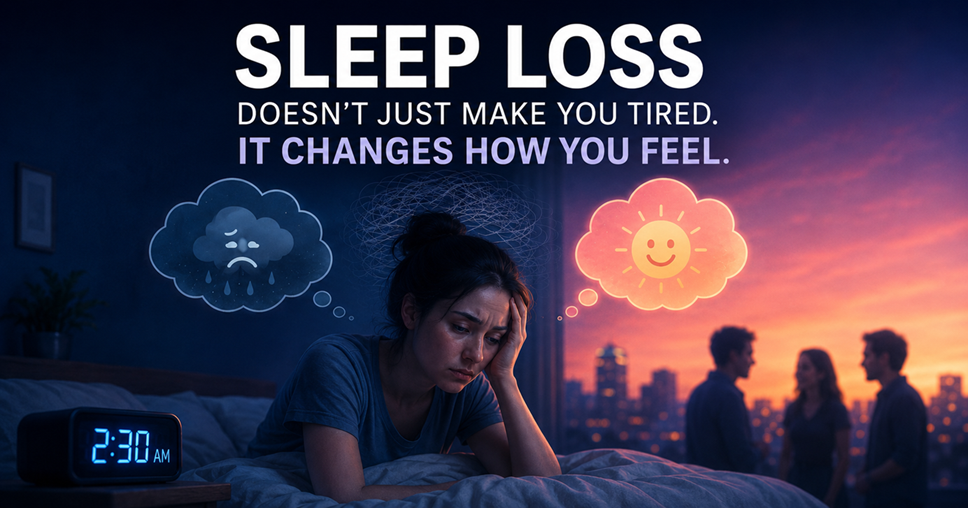
Sleep Loss Doesn’t Just Make You Tired. It Changes How You Feel.
August 26, 2026
A bad night may do more than drain your energy. It can quietly change how rewarding life feels, how strongly you experience anxiety, and even how you connect with other people.
You probably know the feeling.
You sleep badly, wake up tired, drink some coffee, and try to continue your day as usual.
But something feels different.
A minor problem seems harder to handle. A conversation feels more irritating than it normally would. You have less patience. Less enthusiasm. Maybe even less desire to talk to anyone.
We usually describe this as being tired.
Sleep science suggests something more interesting is happening.
Sleep loss may temporarily change the way we experience our emotional world.
The First Thing We Lose May Not Be Happiness — But the Ability to Feel It
One of the largest analyses of experimental sleep-loss research combined 154 studies involving more than 5,700 participants.
The clearest finding was surprisingly consistent:
Sleep loss reduced positive emotion.
People reported less enthusiasm, happiness and positive affect after total sleep deprivation, partial sleep restriction and disrupted sleep.
And this effect was often more consistent than increases in negative mood.
That distinction matters.
We tend to imagine sleep deprivation as something that makes us feel worse.
But the science suggests that one of its strongest effects may instead be that it makes us feel good less easily.
A good meal may feel slightly less rewarding.
An enjoyable conversation may feel less engaging.
Something you would normally look forward to may suddenly seem like effort.
In other words, sleep loss may not simply add negativity.
It may subtract positivity.
You Don’t Need an All-Nighter
It would be easy to dismiss these findings by thinking:
"Of course people feel terrible after staying awake all night."
But severe sleep deprivation is not the only problem.
In one controlled study, adults reduced their sleep from approximately 7.4 hours to 6.2 hours per night for six weeks.
The result?
Participants reported higher stress and anxiety.
That is important because this looks much more like real life.
Many people are not staying awake for 24 or 36 hours.
Instead, they lose an hour here.
Forty-five minutes there.
They go to bed late for several nights and tell themselves:
"I'll catch up this weekend."
The emotional consequences of sleep loss may therefore begin well before we would describe ourselves as severely sleep deprived.
Sleep Also Helps Us Regulate What We Feel
Emotions themselves are only half of the story.
We also constantly regulate them.
A frustrating email arrives.
Someone criticizes us.
Traffic makes us late.
Something embarrassing happens.
Normally, the brain does more than generate an emotional response. It also helps us interpret, inhibit and regulate that response.
Experimental research suggests sleep deprivation can weaken this top-down emotional control.
Sleep-deprived participants have shown more difficulty intentionally reducing their reactions to negative emotional material.
Neuroscience offers a possible explanation.
Research has repeatedly implicated interactions between the amygdala, which plays an important role in emotional salience and threat processing, and regions of the prefrontal cortex involved in higher-order regulation.
After sleep loss, these systems appear to communicate differently.
The popular description of the tired brain as simply slower may therefore miss something important.
It may also be less emotionally regulated.
Then Something Even More Interesting Happens: Other People Change Too
Perhaps the most fascinating findings appear when researchers move beyond individual mood.
Sleep loss can influence social behaviour.
In experimental research, sleep-deprived participants kept greater physical distance from other people and reported greater feelings of loneliness.
Other studies have linked sleep loss with:
- reduced empathy,
- less helping behaviour,
- poorer recognition of some facial emotions,
- lower interpersonal trust,
- and more difficult social interactions.
One experiment even found that experimentally fragmented sleep — participants were awakened repeatedly during the night — reduced empathic sensitivity and prosocial decisions the following morning.
You do not have to be awake all night for sleep disruption to affect how you relate to others.
This creates an intriguing possibility:
A bad night does not remain inside the person who slept badly.
It can enter conversations, relationships, workplaces and social interactions the next day.
Can You Just Catch Up on Sleep?
Recovery sleep certainly helps.
But the evidence suggests recovery is not always immediate or complete.
Different functions appear to recover at different speeds. Sleepiness may improve while some cognitive or emotional effects persist.
A single long night of sleep therefore should not necessarily be thought of as an instant biological reset button.
Sleep history matters.
The Bigger Idea
For decades, sleep deprivation was often discussed primarily as a problem of attention, memory and performance.
Those effects are real.
But a broader picture is emerging.
Sleep is also deeply connected to our emotional and social functioning.
When sleep is reduced, we may:
feel less positive,
experience more anxiety,
regulate emotions less effectively,
and sometimes withdraw from other people.
So after a bad night, the world around you may not actually have become more frustrating, less rewarding or less friendly overnight.
Something else may have changed.
The brain experiencing that world did not get enough sleep.
What the Evidence Does — and Doesn't — Say
Not every emotional effect of sleep loss is equally strong, and individual responses vary considerably.
Research is especially consistent for reduced positive affect and increased anxiety, while findings involving specific negative emotions and emotional reactions are more mixed.
Sleep duration is also only one part of healthy sleep. Sleep quality, continuity, timing, regularity, age, health and individual biology all matter.
So the scientific message is not:
“One bad night will ruin your emotional health.”
It is more nuanced — and more interesting:
Sleep is not simply downtime for the brain. It is part of the biological system that helps us experience and regulate our emotional lives.
Key Takeaway
Sleep loss doesn't only change how awake you feel. It can change how rewarding life feels, how effectively you regulate emotion, and how you relate to the people around you.
And sometimes, the first sign that you need more sleep may not be your eyelids.
It may be how the world feels.
Selected Scientific Evidence
- Palmer, C. A., & Alfano, C. A. et al. — Sleep Loss and Emotion: A Systematic Review and Meta-Analysis of Over 50 Years of Experimental Research.
- Simon, E. B. et al. — Sleep Loss Causes Social Withdrawal and Loneliness.
- Simon, E. B. et al. — Sleep Loss Leads to the Withdrawal of Human Helping Across Individuals, Groups, and Large-Scale Societies.
- Stenson, A. F. et al. — Experimental research on sleep deprivation and top-down emotion regulation.
- Benasi, G. et al. — Research on sustained mild sleep restriction, stress and anxiety.
This article summarizes scientific research and is intended for educational purposes. It is not medical advice.